Sunday, June 6, 2010
Building a well on Samui
Saturday, February 20, 2010
Tambun Sala Koy
Here's a very old Samui tradition that I happen to stumble over today. My wife asked me to bring our son to her Mum and Dad at Wat Plai Laem but if they weren't at the Temple or Wat, they would be at the sea. Good luck finding it and if you have problems call Dad!
Saturday, January 23, 2010
OTOP Samui, Coconuts at Lipa Noi
Remember or ever heard of the OTOP program, One Tambon One Product, very popular under Thaksin Shinawatra's reign over Thailand.
Wednesday, October 21, 2009
A day in Nathon
As the title of this post already mentioned, we spent some time in Nathon today. This is where the Municipality is located and all other important government offices, including Immigration.
It's also the town on Samui that reminds me the most of mainland Thailand, since it's the least touristic town, compared to Chaweng and Lamai, to name the other two bigger towns. Interestingly enough, it hasn't changed that much since 10 years ago when I arrived on Samui. Sure, there's a new Seatran pier and a small Tesco Lotus, but the main structure and infrastructure hasn't changed that much at all.
Interestingly enough, the only supermarket or what you could call a supermarket was Samui Market, located on the main road. It had the only moving stairs on the island and 29 days out of 30 they seemed not to work! On a quick visit today they were holding to tradition and we had to walk them up rather than being moved up!
Monday, October 12, 2009
Island life
A day in the life of an islander it almost seems like in this post. This morning I was well on my way to Nathon to visit the local Immigration office to pick up the stamp for my yearly visa extension when we firstly encountered a massive black smoke plume over Maenam, similar to the one there was a bit over a year ago when a car crashed into the 7-11 in Bang Rak.
Tuesday, July 1, 2008
Hainanese style houses on Samui
In my blog post last week about the Chinese Temple in Hua Thanon, I mentioned
a Hainanese legacy on Samui. Over the weekend, when we visited the waterfall in Baan Namuang, I went back to Hua Thanon to take some pictures of typical Hainan style houses.
Here are three perfect samples of such Hainan style houses in Hua Thanon, as you can see, they're made of wood and typically have two floors. This one seems to be housing a motorbike repair shop.
Here's an other prime sample of a stand alone Hainan style house in Hua Thanon.
This is also a typical sight in Hua Thanon, a few Hainan style houses next to each other, build in to a variety of shops or restaurants.

Here's a sample from a Hainan style house in Nathon, converted in to a restaurant.
Another excellent place to find houses build in this style are in Nathon and Bophud, although in Bophud, a lot of the original houses have been renovated but it has been done in a nice authentic way giving it a modern flair.
Camille
BTW It's 10 am and it has drizzled and rained pretty much from 8 am onwards and there's a rather dark, cloud filled sky.
Saturday, June 14, 2008
House inauguration of Aunties house
The whole family gathers, including the kids and a good time is had by all. It starts a day or so early by cooking all the food for the monks and the relatives and friends that will attend.
My wife went early with the kids, who had a blast playing around with the other kids present and she helped out in the kitchen, preparing dishes and cleaning up.
It all starts out with monks being invited to the house who will chant for an hour or so and than the food is served.
The best food and first choices are given to the monks and the rest of the friends and family eat outside on the balcony and other rooms, the monks get to eat in the living room. Once the monks are finished, the food that they didn't eat is shared by the other visitors. Everything that's left over goes into the 'doggy bags' and is taking home by the various friends and relatives.
The ceremony is concluded by the main monk who paints a good luck charm on top of the front door. Before that the monks have strapped a very thin white cotton rope around the house.
Each new build house or shop, gets an inauguration like this in Thailand.
Camille
Thursday, November 22, 2007
Natural Museum Lamai, part 2
After my post of part 1 of the Natural Museum in the Temple in Lamai, I thought it to a good time to post some more pictures about this fascinating place.

There's a big cabinet displaying all kinds of various Thai bank notes through the 'ages'. There are quit a few that I remember, even the 10 Baht notes and also a wide variety of 50 and 500 Baht notes. Interesting to see, in my humble opinion.
These 3 vases are also on display. Chinese I would guess, they're beautiful but unfortunately there's absolutely no information on them whatsoever.
There are a few (push) bicycles on display as well, to my rather big surprise. Than again, some of the things on display will most certainly raise a few eyebrows, rather obscure to say the least but I think that's also part of the charm of the place.
An intricate weighing system, similar to one that my wife's Mum used to have, a long time ago.

This is a very interesting set of items. Have a good look, see anything strange? Did you notice their iron or steel tongues sticking out? These figurines are all used to split the coconuts open, so the coconut flesh can be taken out. This is some real good and original Samui tradition on display. Similar items can sometimes still be seen in use in real life nowadays, although the 'tongues' aren't attached to such beautiful tongue holders. Most of the time it's just a steel rod connected to a piece of wood.
As already mentioned in some posts, Samui used to be Thailand's main coconut provider, until a few years back, tourism took over as the main financial provider for the island.
A funny anecdote about the coconuts is this one;
In the older days, not even too long ago, all the 'good land', being land with lots of coconut trees on it, was given to the favorite sons and/or daughters and the less popular off spring 'got stuck' with the worthless beach land. In the more popular areas like Chaweng, beach land goes nowadays for anywhere between 30 to 50 Million Baht per Rai.
Hope you enjoy these pictures and make sure to visit this Natural Museum in Lamai.
Camille
Saturday, November 17, 2007
Natural Museum Lamai, part 1
Since the day started out beautifully with a blue sky, we decided to go on a trip to the Southern part of Koh Samui, the Lamai, Baan Taling Ngaam and Lipa Noi area's.
It was also part of my plan to visit two temples of which I recently found out that they supposedly have mummified monks in them. Since this came as big surprise to me, I had to investigate this. The only mummified monk I'm aware of on Samui, is in Wat Kanuram, about whom I posted already.
At the first temple we visited today, in the middle of Lamai so to speak, a pleasant surprise was sprung on me. The temple houses a Natural Museum, in all it's fantastic, dusty museum glory, filed far away on a second floor, inside the temple grounds, where time just had stood still and plenty of traditional Samui tools and artifacts are collecting dust and waiting to be discovered. I took so many pictures in this museum alone that I can easily cover three or four posts about this place. Today part 1.
The temple in question is located on the ring road and driving from Lamai to Nathon, there will be a very hard left turn in the road, that's where the temple is located, at your right hand.

Once you enter he temple grounds, pretty much straight ahead, is a 'mummified monk' who's not that mummified at all but is still very fascinating, more on him on a different day.
The museum is at your left hand, across a fairly big open space. There are stairs in the left hand corner, after you crossed the open space, that lead up to the museum and here's a picture of the museum signs.
Inside you get the feeling that time stood still. There's a back row of glass cabinets and lots of artifacts are located seemingly randomly in the big room, housing the museum. It was a pleasant surprise for me to find out that there was a museum at all but even more pleasant was to find that it is one of these absolute charming places where you just wander around and it just tastes like times long gone by. No explanations are given so it's a good thing my wife knows and/or recognises plenty of the displayed items and what they were used for!
It was really nice to find a very small corner of the floor being dedicated to the old tradition of fishing, something that on Koh Samui comes natural to many on the island. A fishing net and various fish traps are being displayed.
Some of the cabinets have just the most wonderful and seemingly completely random items displayed, in cabinets, like this one here. Some teak wood figurines next to an old 6-tees vinyl 'pick up' player which on it's turn sits next to an old gramophone player with a big horn on it! Makes no sense at all but they look just fabulous.
This wooden construction is an old style 'machine' to make khanom chin, a kind of Thai spaghetti.Today was a very nice day, we saw lots of interesting places, met some nice people and found some true gems on Koh Samui, well worthwhile visiting, amongst others this Natural Museum in Lamai and there's more to come on this place, in part 2!
Camille
Saturday, November 10, 2007
Beautiful Samui pictures........
Besides having joined the Thron Tree forum and stumbling over Tezza's website, I also recently stumbled over Monique's Land of Smiles website. She's Dutch and lives on Samui and took photography on as a hobby, the results are just stunning.
Especially after the recent stretch of rain and bad weather, I thought it to be a pleasant change to view some of Monique's pix.
Enjoy.
Camille
Friday, October 12, 2007
Khanom Chin food stall in Bang Po
Today, early in the morning, I had to go the Immigration office in Nathon, to see if my yearly Non Immigrant B Visa had arrived. After a bit of waiting and some stamps and signatures in my passport, I could happily embrace my new one year Non immigrant B visa.
On the way out of Nathon, after having done some various errands along the way, we were all hungry and my mother in law, who came along for the trip, suggested to go and eat Khanom Chin in Bang Po, in this supposedly excellent place for this kind of food.
Khanom Chin are Chinese style noodles with a Curry on top. Especially in the South of Thailand, these curries are very spicy but Khanom Chin is in general eaten throughout Thailand.

This is how the place looks like, it's located at the ring road, in Bang Po, the North of the island, and it looks like a shack.

It's mainly visited by locals, since they serve a very traditional Samui style curry and everybody just kind a joins around this big, table like thing. At one end the food is prepared and at the other three sides of the tables one can sit down and eat.
Rice is not served but they do serve a soup as well, a Long Thong.
These are the various vegetables (Pak) that go along with the Curried Khanom Chin.

Here's the famous Khanom Chin, doused in a very spicy curry.

Since I'm not a big fan of Khanom Chin at all, I had to go for the only alternative available, the Long Thong soup. The soup was very good and I ended up ordering a second bowl, since one wouldn't stop my appetite.
As a dessert I had this Lot Chong, the only Thai style dessert I actually like.
If you're in for a somewhat more adventurous eating experience, in sharp contrast to yesterday's Prego experience, this can be advised.
Camille
Tuesday, October 2, 2007
100 days ago

As usual, monks are involved to participated in the ceremony. Here they can be seen walking back to the temple, directly after the ceremony. The tomb is in the background.

All family members present have a moment of silence and prayer in front of the tomb, were they also place burning incense.
After all this, it was time to eat again. Massive amounts of food were cooked overnight, to be distributed amongst the monks (they get the best pieces!) and the family members, either to eat at the temple or to take home.

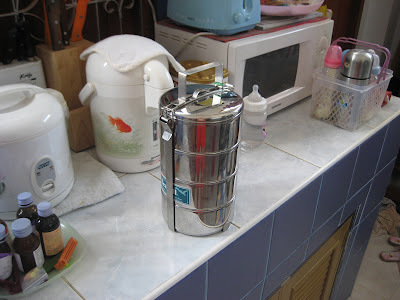
We did a bit of both, had some food at the temple and took some food home, in one of the container in the picture above. These containers can be seen all over Thailand and are actually very handy. Food can be placed in 4 different containers (4 different dishes!) and people carry them around all over the place, varying from 2 to 4 containers in height.

Here's the content of the containers, from left to right, a curry for Kanom Chin (Thai noodles), pork, Naam Som Plaa ( a spicy fish curry) and sweet Pork with Eggs.
The curries are both very spicy, something the South of Thailand is well know for, it's spicy curries. However, this calls for a different posting, the various foods in the various regions of Thailand.
Camille